

Good aesthetic patients do not always tell you when something changes.
They do not necessarily complain.
They may not leave a bad review.
They may not ask for a manager.
Sometimes they smile, thank you, walk out—and simply never book with you again.
That is what makes patient retention difficult.
A 2025 international survey of 1,612 experienced cosmetic neurotoxin patients found that after respondents’ least-positive treatment experience, only 22% said they directly expressed dissatisfaction to the injector, while 30% planned to switch providers. [1]
So the dangerous assumption is:
“They didn’t complain, so everything must have been fine.”
Silence does not tell you that.
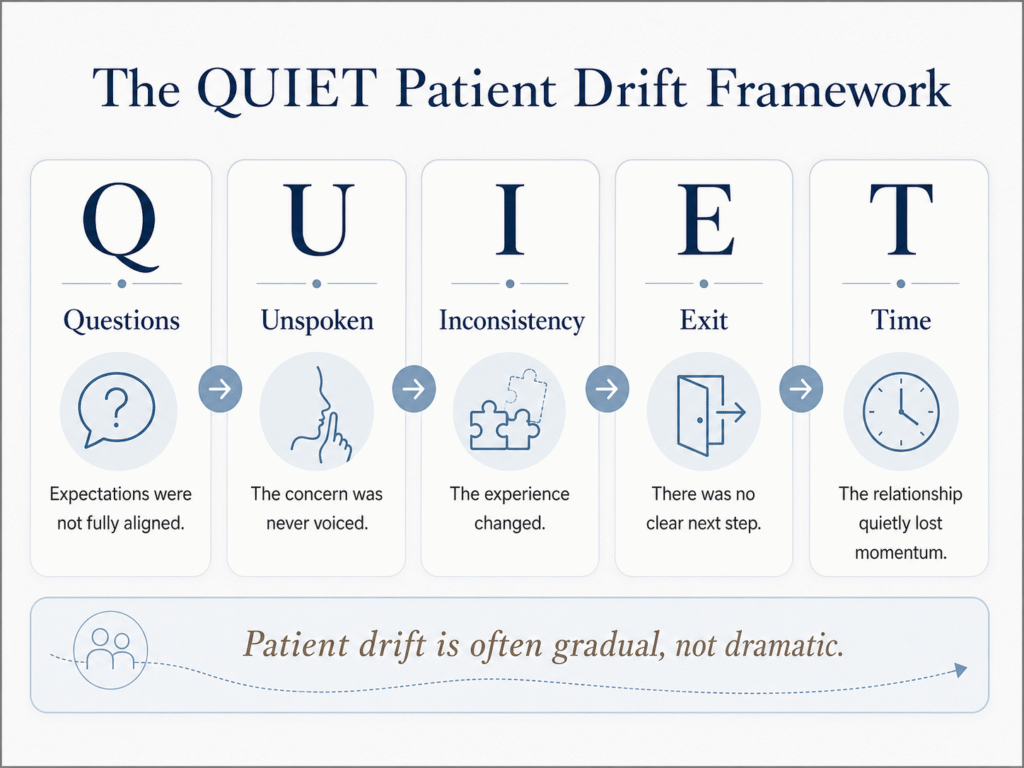
Good patients can disappear because expectations were never completely aligned, trust weakened, the experience became inconsistent, nobody defined the next step, or the relationship simply lost momentum.
And sometimes their disappearance has nothing to do with you at all.
The challenge is learning the difference.
A useful way to think about preventable patient drift is:
Questions → Unspoken dissatisfaction → Inconsistency → Exit → Time
Or simply:
QUIET.
1. Silence Is Not the Same as Satisfaction
Most providers expect unhappy patients to tell them.
Some do.
Many do not.
The 2025 Patient Voice in Aesthetic Medicine study is particularly useful here because researchers asked experienced cosmetic neurotoxin patients what they actually did after their most and least positive treatment experiences.
Following respondents’ least-positive experience, only 22% said they expressed dissatisfaction directly to their injector. Meanwhile, 30% reported plans to change healthcare professionals. [1]
That does not mean those numbers apply to every aesthetic patient.
The study involved experienced neurotoxin patients in four countries, relied on retrospective self-report, had limitations inherent to online survey research, and was industry sponsored.
But it exposes something every provider should understand:
You may never receive the complaint that explains why the patient left.
That is why appropriate follow-up and genuine feedback matter.
Not because every patient needs to be chased.
Because silence is incomplete information.
2. The Result May Have Been Fine—but the Relationship Changed
Providers understandably focus on the result.
Patients do too.
But results are not the only thing influencing whether someone returns.
The Cosmetic Injectable Patient Experience Exploratory Study—CIPEES—asked patients to rank reasons they would return to a previous cosmetic injector.
The number-one ranked factor was trust in the practitioner’s actions and ability, followed closely by the previous cosmetic result. Connection and understanding with the practitioner ranked third. [2]
That matters.
A technically acceptable appointment can still leave a patient wondering:
- Did they actually listen to me?
- Did I feel rushed?
- Did I understand the recommendation?
- Did I feel comfortable asking questions?
- Did the provider remember what mattered to me?
- Did I feel cared for—or processed?
Another CIPEES analysis found that qualifications and training ranked first among factors contributing to trust, followed by reputation and the amount of time and explanation provided. Listening was also highly rated in developing rapport. [3]
Patients experience your competence through the relationship surrounding it.
You can perform technically strong work and still gradually lose trust if the experience becomes rushed, impersonal, inconsistent, or unclear.
3. The Patient’s Expectations and Yours May Have Drifted Apart
A patient can leave satisfied with parts of the experience while still feeling that something did not quite match what they expected.
That is particularly important in aesthetics because terms such as:
“Natural.”
“Refreshed.”
“Subtle.”
“Noticeable.”
“Balanced.”
can mean different things to different people.
A 2026 narrative review of patient-surgeon communication in aesthetic surgery highlighted the difficulty patients can have articulating aesthetic goals and emphasized structured expectation management and communication as important tools for improving alignment. [5]
That review concerns aesthetic surgery rather than injectable treatment specifically, so it should not be treated as a direct injectable benchmark.
But the communication lesson is useful.
Do not assume the patient and provider mean the same thing simply because they use the same word.
Ask:
“What were you hoping would feel different?”
“How does the result compare with what you expected?”
“Is there anything you weren’t expecting?”
“What would you want us to understand before your next visit?”
Those questions can uncover small disconnects before they become quiet exits.
4. The Experience Became Inconsistent
Patients notice inconsistency quickly.
Maybe the first visit felt thoughtful and unrushed.
The next one felt hurried.
Maybe the provider explained everything carefully at first but assumed an established patient no longer needed the same attention.
Maybe one team member was warm and organized while another seemed distracted.
Maybe appointment communication changed.
Maybe nobody remembered what the patient had already discussed.
Consistency does not mean every appointment should sound scripted.
It means the patient should be able to depend on your standards.
Broader healthcare research reinforces this relationship between communication and trust. A 2026 systematic review of 13 studies found that clear information, empathy, active listening, shared decision-making, and supportive nonverbal communication were generally associated with stronger patient trust. [4]
The research is broader than medical aesthetics, but the principle is directly relevant:
Trust is easier to maintain when the patient’s experience of you is reliably trustworthy.
5. The Appointment Ended Without a Next Step
Sometimes nothing went wrong.
The patient simply left.
No next appointment.
No understanding of when they might appropriately return.
No clear follow-up.
No conversation about what comes next.
Then three months becomes six.
Six becomes nine.
And eventually the patient’s next aesthetic decision starts from zero again.
A provider does not need to turn every visit into an aggressive rebooking pitch.
But patients should understand the next appropriate step when one exists.
That might be:
- A scheduled follow-up.
- A future appointment.
- A suggested time to reconnect.
- A treatment-plan milestone.
- Instructions to contact the practice when ready.
- No next treatment at all, when that is appropriate.
The point is clarity.
A 2026 Zenoti benchmark based on aggregated, anonymized North American med-spa platform data illustrates how fragile that early rebooking stage can be. Among med-spa locations where guests had been rebooked once, 37% of those appointments were later cancelled; the cancellation level reported after multiple rebooks was substantially lower. [6]
That is platform-specific business data—not a universal clinical benchmark—and individual practices will differ.
Still, the operational lesson is useful:
Putting something on the calendar is not the same as building continuity.
The patient still needs a reason to value the relationship and confidence in what comes next.
6. Follow-Up Became Either Nothing—or Marketing
There are two common extremes after an appointment.
Extreme one:
The patient hears nothing.
Extreme two:
The patient hears from the practice only when someone wants to sell something.
Neither creates much continuity.
Appropriate follow-up should feel like part of the patient relationship—not an abandoned-cart campaign.
Depending on the practice, situation, treatment, professional role, and applicable requirements, follow-up may involve:
- Checking whether the patient’s experience matched expectations.
- Giving the patient an appropriate route for questions.
- Addressing concerns correctly.
- Documenting follow-up needs.
- Clarifying what happens next.
- Staying meaningfully connected between appropriate visits.
The 2025 neurotoxin survey specifically concluded that consistent proactive follow-up can help practitioners better understand patient perspectives on outcomes. [1]
That is different from constantly promoting another procedure.
Follow-up says, “How was the experience?”
Marketing says, “What else can we sell?”
Patients know the difference.
7. Sometimes Life Simply Got in the Way
Not every patient who disappears is unhappy.
People:
- Move.
- Change jobs.
- Have children.
- Change financial priorities.
- Get busy.
- Experience illness or family responsibilities.
- Change aesthetic goals.
- Decide to stop treatment.
- Find another provider who is more convenient.
- Simply lose track of time.
Do not turn every lapsed patient into a personal rejection.
That is why retention needs both humanity and measurement.
If a patient has not returned, you may know that they disappeared.
You usually do not know why unless you ask.
A simple, respectful re-engagement message can sometimes reopen the relationship:
“We haven’t seen you in a while and wanted to check in. If you have any questions or there’s anything we can help with, we’re here.”
No guilt.
No pressure.
No pretending you know why they left.
8. Build a Patient Continuity Loop
A strong patient relationship should not depend on one provider remembering everything manually.
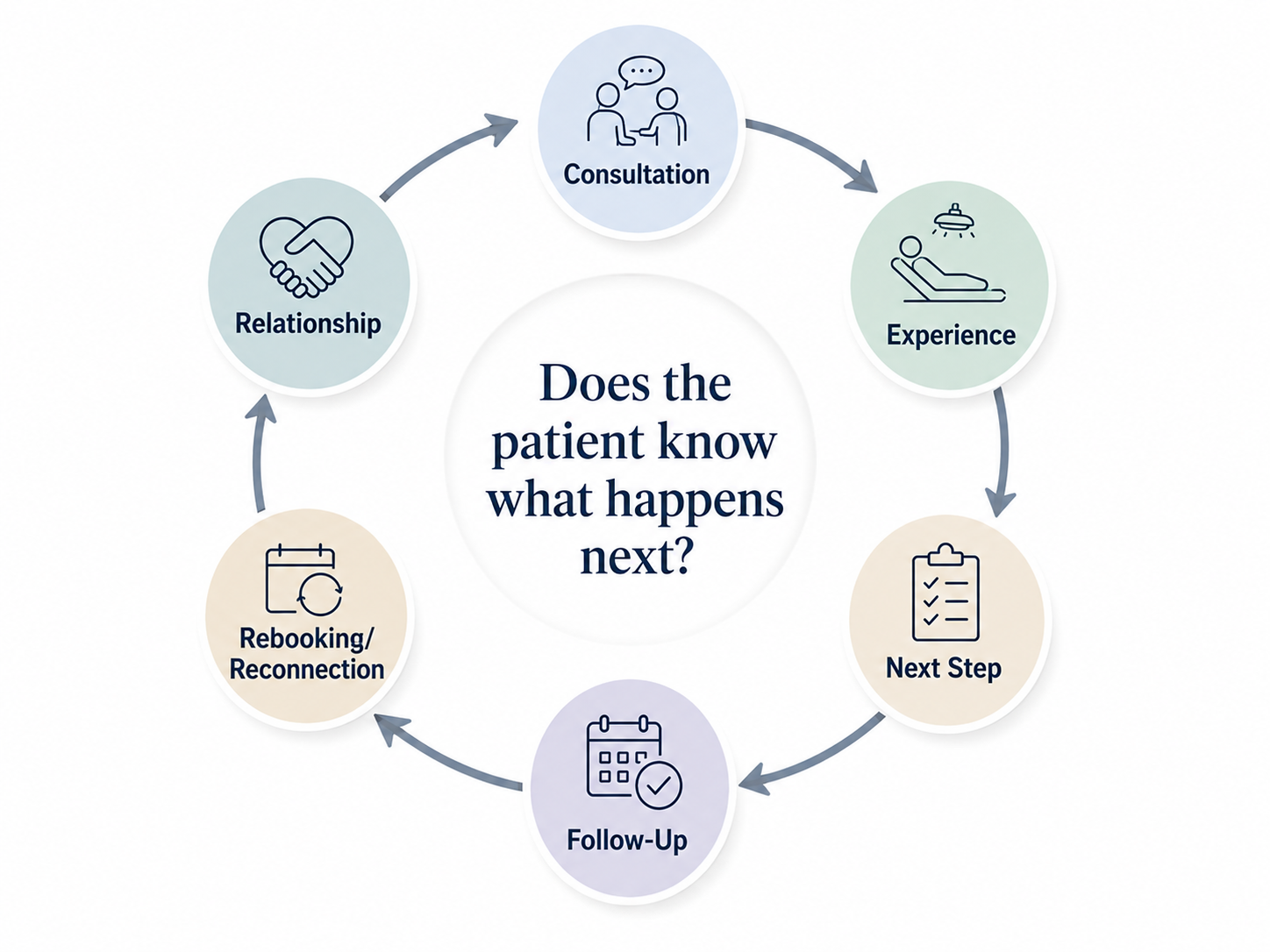
Think of continuity as a loop:
Consultation → Appropriate Treatment → Experience → Next Step → Follow-Up → Rebooking or Reconnection → Relationship
At every stage, ask one question:
Does the patient know what happens next?
If the answer is no, drift becomes easier.
A broader systematic review of 40 U.S. healthcare studies found that positive patient experiences were associated with better retention, greater willingness to recommend, and fewer complaints. Communication and trust were among the aspects of care linked with intent to return. [7]
The research was not specific to medical aesthetics, so it should be used as supporting evidence rather than an injector-specific benchmark.
But it reinforces a basic point:
Patient experience has consequences beyond the appointment itself.
9. Measure the Patients Who Do Not Come Back
Providers often know:
- How many patients they treated.
- How much revenue they produced.
- How full their schedule is.
Fewer can answer:
- What percentage of eligible patients rebook with me?
- How many patients request me again?
- How many established patients have quietly lapsed?
- How many patients return after their first visit?
- How many patients refer someone?
- What reasons do patients give when they do not return?
- Are there specific points in the experience where retention weakens?
You do not need an internet benchmark to start.
Establish your own baseline.
Useful measures might include:
Same-provider rebooking rate
How many eligible patients schedule another appropriate visit with you?
Returning-patient visits
How much of your patient volume comes from established relationships?
Lapsed-patient count
How many previously active patients have moved beyond the practice’s defined return window?
Patient feedback
What do people actually say about communication, trust, clarity, and experience?
Provider-specific referrals
Are patients comfortable recommending you specifically?
The exact numbers will vary by treatment mix, role, practice, patient population, and how each metric is defined.
Track direction before chasing benchmarks.
Frequently Asked Questions
Why do good aesthetic patients suddenly stop coming back?
There is no single reason. Patients may experience unspoken dissatisfaction, expectation mismatch, weakened trust, an inconsistent experience, unclear next steps, poor continuity, scheduling or financial changes, relocation, or simply changing priorities.
The important point is that patients do not always tell providers when they are dissatisfied. In one 2025 international neurotoxin survey, only 22% said they directly expressed dissatisfaction to the injector following their least-positive experience. [1]
Do patients leave even when the treatment result was good?
Yes, potentially.
Results matter, but they are only one part of the experience. In CIPEES Part 2, trust in the practitioner’s actions and ability ranked slightly ahead of the previous cosmetic result as the top reason respondents would return to a previous injector. [2]
Does follow-up improve patient retention?
Follow-up can support continuity and give providers an opportunity to understand the patient’s experience, but there is no single follow-up schedule proven to guarantee retention across aesthetic practices.
The 2025 Patient Voice study specifically emphasized proactive follow-up because dissatisfied patients may not otherwise tell the injector how they feel. [1]
Should every patient leave with another treatment booked?
No.
Rebooking should reflect an appropriate next step, not pressure to generate another transaction.
Sometimes the correct next step is a future appointment.
Sometimes it is follow-up.
Sometimes it is waiting.
Sometimes there is no additional treatment indicated.
Clarity matters more than forcing a booking.
What should an injector do when a patient has disappeared?
Start with respectful curiosity rather than assumptions.
Check whether there was a documented concern, unresolved question, missed follow-up, unclear next step, or normal lapse in communication. When appropriate and permitted by the practice’s policies, use a simple re-engagement message that gives the patient an easy way to reconnect without guilt or pressure.
Is patient retention mainly a practice responsibility or an injector responsibility?
Both contribute.
Providers influence trust, communication, expectations, recommendations, consistency, and the patient relationship.
Practices influence scheduling, reminders, handoffs, follow-up systems, accessibility, records, and overall service experience.
Great retention happens when the relationship and the system support each other.
Good Patients Rarely Announce Their Departure
The patient who complains gives you information.
The patient who disappears gives you a mystery.
That is why strong providers pay attention before the relationship goes quiet.
Listen carefully.
Align expectations.
Be consistent.
End with clarity.
Follow through appropriately.
Measure whether patients actually return.
And when someone disappears, do not immediately assume they were unhappy—or assume everything was fine.
Find out what you can.
Learn from it.
Then make the next patient relationship stronger.
A patient relationship usually isn’t lost in one dramatic moment. More often, it fades through small moments nobody noticed soon enough.
Explore Injector Success resources for building stronger patient trust, retention, professional reputation, and long-term career value.